

PRP has the bigger evidence base and remains the safer default for most people with early to moderate hair loss. Exosome therapy shows promising early results, average density gains of around 28% in small trials, but it’s still considered an emerging option rather than a proven standalone treatment. Neither one is universally “better.” The right choice depends on your hair loss stage, how your scalp has responded to treatment before, and how much unproven risk you’re comfortable taking on.
If you’ve been searching for a hair loss treatment in Indore and keep running into both terms without a clear answer, you’re not alone. Here’s what the actual research says, not what a clinic’s marketing page wants you to believe.
What Is PRP, Actually?
PRP, or platelet-rich plasma, uses your own blood. A small sample is drawn, spun in a centrifuge to concentrate the platelets, and then injected into your scalp. Those platelets release growth factors that nudge resting hair follicles back into an active growth phase.
PRP’s biggest advantage is time. It’s been used for hair restoration for over 15 years, and a 2025 meta-analysis pooling 43 randomized trials and nearly 1,900 patients found it genuinely effective for increasing hair density, though it didn’t significantly improve hair thickness on its own. Because it comes from your own blood, there’s also no sourcing or quality-control question hanging over it.
Where PRP tends to work best:
- Early to moderate androgenetic alopecia (pattern hair loss)
- Telogen effluvium (stress or hormone-related shedding)
- Supporting recovery after a hair transplant
- Patients who want an established, well-studied option over a newer one
What Is Exosome Therapy?
Exosome therapy is newer, and it works differently. Exosomes are tiny particles derived from stem cells, essentially cellular messengers carrying growth factors and repair signals. Instead of using your own blood, a prepared exosome solution is injected directly into the scalp.
Because there’s no blood draw or processing step, sessions are often quicker. Early studies suggest exosomes may penetrate scalp tissue more effectively and deliver a more concentrated dose of growth signals than PRP does. That’s the appeal. The catch is that the evidence is still thin. Most of what’s published so far comes from small trials, not the large, controlled studies PRP already has behind it. No major regulatory body has approved exosome therapy specifically for hair loss yet, which means quality and sourcing genuinely matter more here than with PRP.
Where exosome therapy currently fits best:
- Patients who’ve already tried minoxidil, finasteride, or PRP without enough improvement
- As an add-on alongside a hair transplant, not usually as a standalone first step
- People comfortable trying a newer, less-established option after a real conversation about the limited long-term data
Where Does GFC Fit Into This?
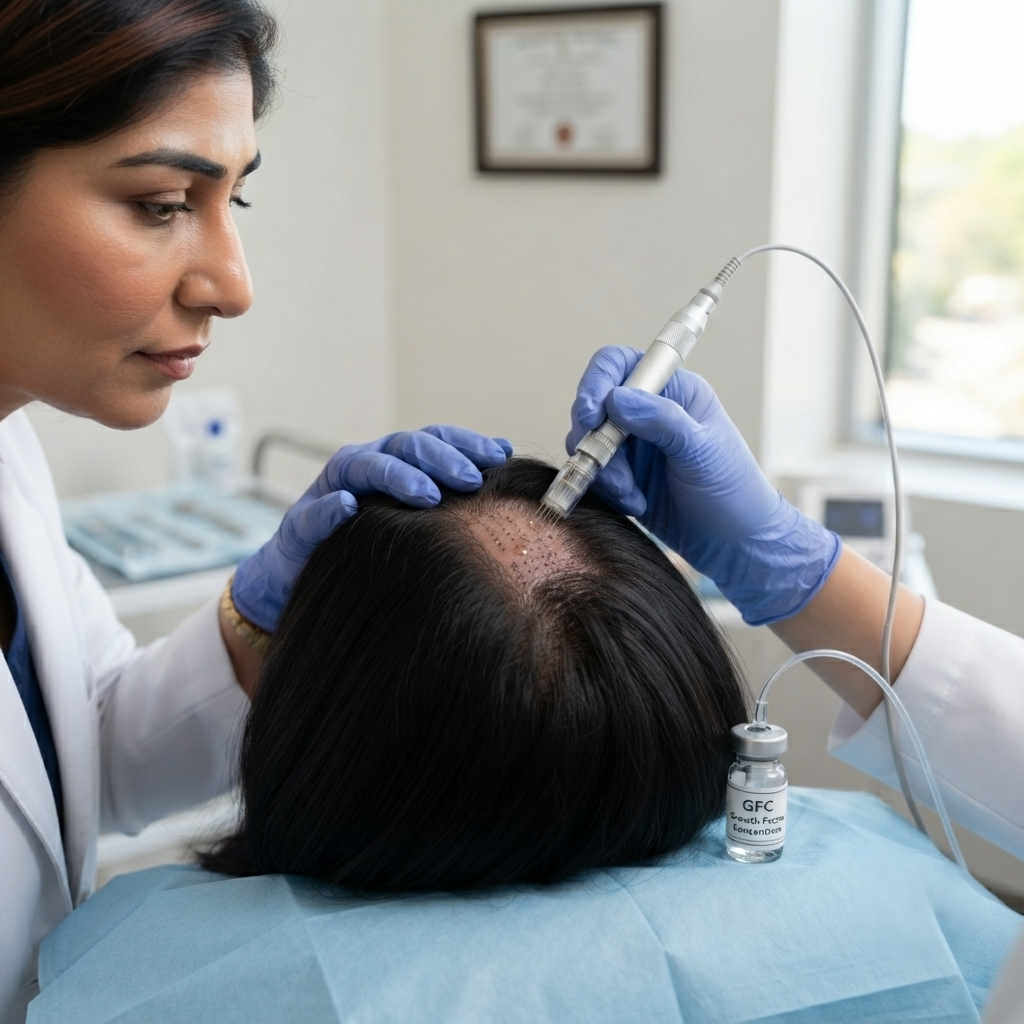
If you’ve also come across GFC treatment in Indore while researching hair loss, it’s worth a quick explanation, because GFC is often grouped with PRP and exosome therapy without clearly explaining the difference. GFC, or Growth Factor Concentrate, sits somewhere between the two. Like PRP, it is prepared from your own blood, but through a different processing technique that produces a more concentrated growth-factor preparation for injection. Some dermatologists use GFC as an alternative to standard PRP, particularly for patients who haven’t responded as expected to PRP. It isn’t the same as exosome therapy, and it isn’t simply “better PRP” either. It’s a separate treatment option with its own place in a hair-loss treatment plan, and whether it makes sense for you depends on the cause of your hair loss and how your scalp has responded to treatment so far.
So Which One Should You Actually Choose?
There’s no single right answer here, but there is a genuinely useful way to think about it:
- If this is your first regenerative treatment: PRP is the more sensible starting point. It has more data, a longer safety record, and costs less.
- If you’ve already tried PRP and saw limited results: exosome therapy or GFC may be worth discussing as a next step, not a replacement from day one.
- If your hair loss is advanced: neither treatment alone is likely to be enough, and combining regenerative therapy with a hair transplant or medical treatment is usually the more realistic path.
- If cost matters as much as results: PRP remains the better value option relative to the evidence it offers.
Not sure which stage your hair loss is actually at?
Guessing between treatments wastes both time and money. A proper scalp evaluation settles it in one visit, before you spend on either option.
What This Looks Like in Practice
At Skinology, patients rarely walk in already knowing which treatment is right for them, and that’s normal. A hair specialist in Indore, Vijay Nagar, should be evaluating your hair loss pattern, scalp condition, and history with previous treatments before recommending anything, not selling you the newest, most expensive option by default.
Our approach starts with a proper scalp and hair analysis. From there, whether the right next step is PRP, GFC, or a discussion about exosome therapy depends entirely on what your scalp actually needs, not on what’s trending. If you’re earlier in your research, our guide to PRP hair treatment in Indore walks through session specifics, recovery, and what to realistically expect from that option alone.
A Word on Cost
Neither treatment has one flat price, and any clinic quoting you a number before an actual scalp assessment is guessing. What genuinely affects cost:
- Which treatment, or combination, your plan actually needs
- How many sessions your hair loss stage typically requires
- Whether you’re pairing regenerative therapy with a transplant or medical treatment
A dermatologist offering a real hair regrowth treatment in Indore plan will walk you through this after assessing your scalp, not before.
Frequently Asked Questions
1. Is exosome therapy better than PRP for hair loss?
Not definitively, based on current evidence. Exosome therapy shows promising early results, but PRP has a far larger body of research behind it. No large head-to-head trial has settled which one wins outright.
2. Is exosome therapy safe for hair loss treatment?
Early studies suggest it’s generally well tolerated, but because it’s not derived from your own body like PRP, sourcing and product quality matter significantly. This is one of the biggest reasons to choose a clinic carefully rather than the cheapest option available.
3. How many sessions of PRP or exosome therapy do I need?
Most PRP plans involve three to four sessions spaced four to six weeks apart, followed by maintenance every few months. Exosome protocols tend to follow a similar spacing, though this is confirmed based on your specific scalp assessment.
4. Can PRP and exosome therapy be combined?
Sometimes, particularly for patients with more advanced hair loss or those already planning a hair transplant. This isn’t a standard first step and should be discussed directly with your dermatologist.
5. Is exosome therapy FDA approved for hair loss?
No, not currently, in the US or elsewhere. It’s used as an emerging regenerative option, which is exactly why the evidence base is still considered “promising but immature” rather than established.
6. What’s the difference between GFC and PRP for hair loss?
Both come from your own blood, but GFC is processed differently to concentrate growth factors more heavily than standard PRP. It’s sometimes recommended for patients who haven’t responded well to regular PRP sessions.
The Honest Bottom Line
If you want the treatment with more data behind it, PRP is still the safer starting point for most people. If you’ve already tried that route and want to explore something newer, exosome therapy is a reasonable next conversation to have, with realistic expectations about how early the research still is. Either way, the decision should come after an actual scalp evaluation, not a sales pitch.
At Skinology, that evaluation comes first, always. Book a consultation and find out which option PRP, GFC, or exosome therapy, actually fits your hair, not just what’s newest on the menu.